
Program on “Localizing Disaster Risk Reduction (DRR) and Enhancing DRR Governance”
at Bagmati Province
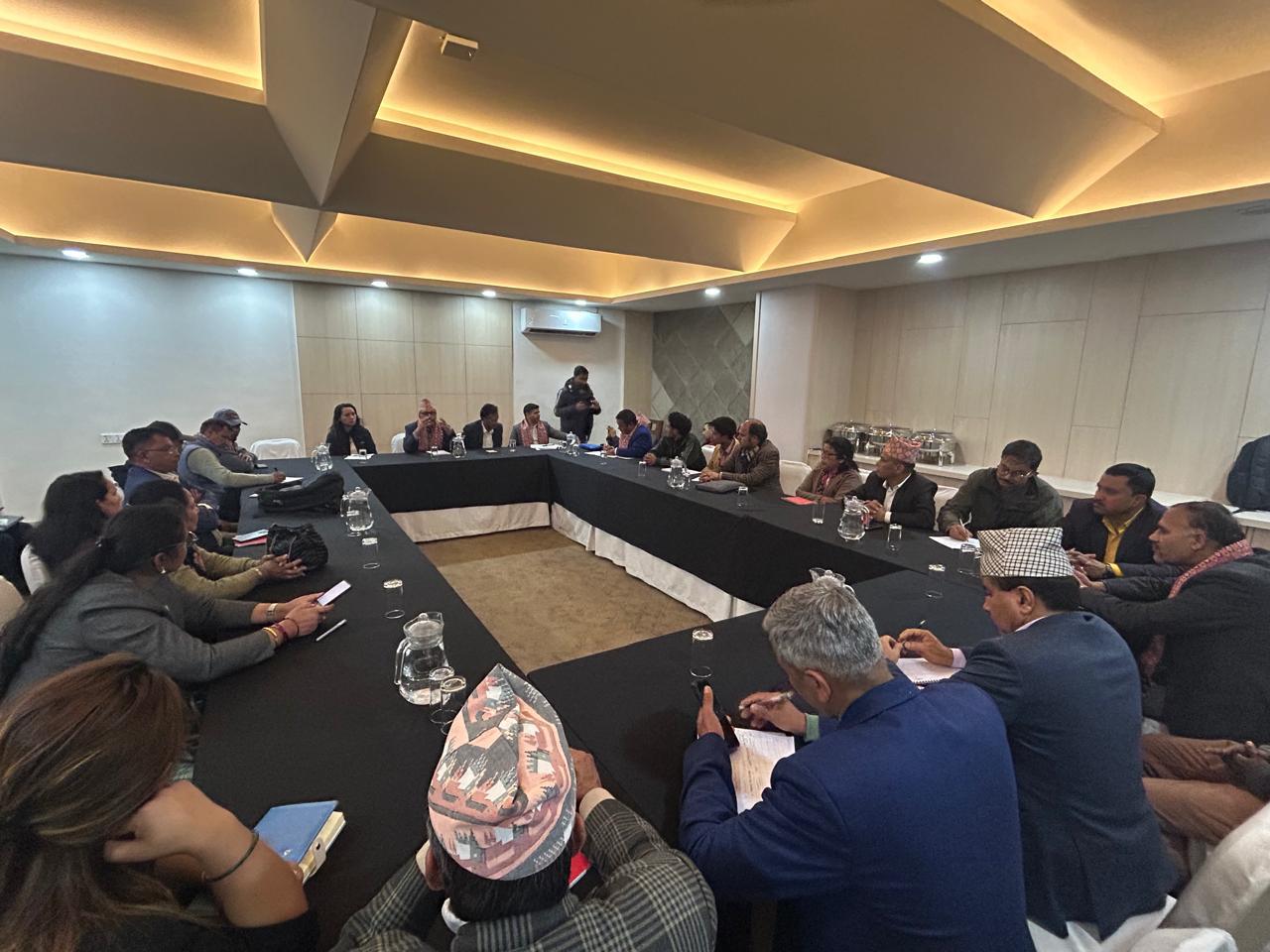
On September 23, 2024, Hetauda in Bagmati Province hosted an important discussion program focused on localizing
Disaster Risk Reduction (DRR) and enhancing governance in disaster management. The event was chaired by Ms.
Ramila Sapkota, Chairperson of the NGO Federation of Nepal in Makawanpur, with Hon. Prem Bhakta Maharjan, the
Minister for Transport, Labor, and Employment, serving as the chief guest. Among the attendees were key figures
such as Mr. Tirtharaj Chiluwal, Chief District Officer of Makawanpur; Mr. Lalit Glan, Chief of the District
Coordination Committee; and Mr. Suresh Khanal from the Ministry of Internal Affairs and Law. The welcome address
was presented by Mr. Kamal BK, Chairperson of DPNet Bagmati Province, with significant contributions from Mr.
Jitram Lama, Immediate Past President of the NGO Federation of Nepal, and Mr. Surya Bahadur Thapa, Chair of
DiMaNN and Immediate Past President of DPNet.
In his presentation, Mr. Thapa emphasized the crucial role of DPNet and DiMaNN in advancing DRR initiatives across
Nepal, particularly through effective policy advocacy and coordination. He outlined several areas needing
improvement, such as clearly defining provincial responsibilities based on specific disaster types, fostering
collaboration between security forces and citizens, and enhancing cooperation between government and private sectors
in data management and resource utilization. Mr. Thapa provided a historical context for the establishment of the
National Platform for Disaster Risk Reduction (NPDRR) in Nepal and advocated for the formation of a Provincial
Platform for Disaster Risk Reduction (PPDRR) in Bagmati Province. He also analyzed the region’s vulnerability to
various disasters, including floods, landslides, lightning strikes, and epidemics, urging the need for raising public
awareness about disaster preparedness and promoting inclusive DRR strategies that engage all stakeholders.
The open floor discussion highlighted key issues such as empowering local communities, ensuring adequate budget
allocations for DRR, and improving transparency and accountability in disaster management. Participants agreed on
the necessity for more participatory planning processes and advocated for the mainstreaming of DRR into broader
development plans. The discussion emphasized the importance of establishing multi-stakeholder platforms to foster
collaboration among government agencies, civil society, and the private sector, enhancing coordination and preventing
duplication of efforts. Capacity-building for local leaders and governments was also a recurring theme, along with the
need for training and exposure programs to improve disaster response capabilities.
Participants identified budget allocation as a critical concern, calling for increased financial investment in DRR
initiatives at both local and national levels. They stressed the importance of early warning systems and stronger
coordination among stakeholders to avoid fragmented efforts.
The program concluded with a collective commitment from participants to address the gaps identified during the
discussions and to implement recommendations aimed at building a more resilient Bagmati Province. This initiative,
coordinated by local organizations, proved to be insightful and cost-effective, leaving participants with valuable
lessons and a shared resolve to enhance disaster preparedness in their communities.
Notice: Test mode is enabled. While in test mode no live donations are processed.
Leave A Comment