
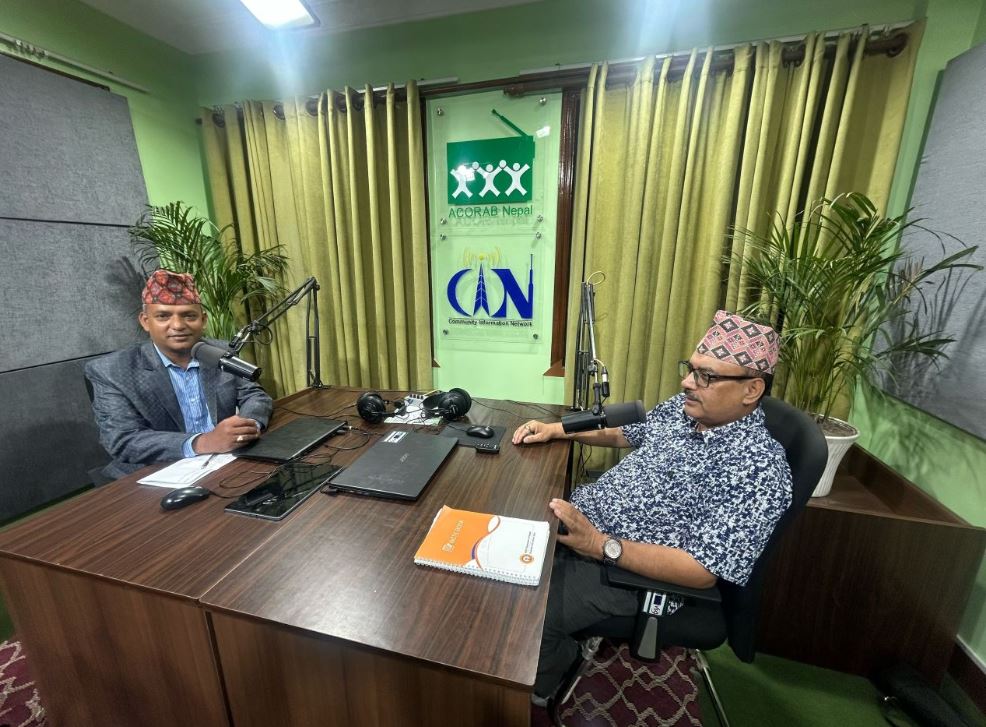
Mr. Surya Bahadur Thapa, Chairperson of the National Disaster Management Network of Nepal (DiMaNN), shared his perspectives on disaster preparedness, emergency response, recovery and reconstruction following the Rasuwa–Bhotekoshi floods of August 2026 during an interview with Mr. Deepak Acharya, Manager of the Community Information Network (CIN). The interview was broadcast nationwide through the CNN Network.
The discussion highlighted the importance of strengthening disaster preparedness, improving early warning systems and risk communication, and enhancing coordination among government agencies, humanitarian organizations, civil society organizations and local communities. Mr. Thapa emphasized the need to better understand cascading hazards, including floods, landslides, riverbank erosion and the formation and sudden breach of natural dams. He underscored the importance of effective risk assessment, timely information-sharing and coordinated preparedness across river basins to reduce disaster impacts and protect vulnerable communities.
The interview also emphasized that disaster response must ensure timely, equitable and transparent assistance to affected households. Reliable damage and needs assessments, effective beneficiary identification, accountability and accessible communication mechanisms were highlighted as essential to ensuring that relief reaches those who need it most. The discussion further stressed that affected communities should remain at the centre of response and recovery, with their local knowledge, priorities and concerns informing decisions and interventions.
Looking beyond immediate relief, Mr. Thapa highlighted the importance of a recovery and reconstruction approach guided by the principle of Building Back Better. This includes restoring livelihoods, strengthening resilient infrastructure, reducing future disaster risks and ensuring that recovery interventions address the underlying vulnerabilities of affected communities. He also underscored the role of civil society and community-based organizations in supporting affected populations, facilitating local engagement and strengthening coordination between communities and responsible institutions. Community radio and other local communication channels were recognized as vital for disseminating early warnings, sharing verified information, countering misinformation and conveying community concerns to decision-makers.
A key focus of the interview was the need to strengthen the National Disaster Risk Reduction and Management Authority (NDRRMA) through adequate financial and operational resources, qualified human resources, enhanced institutional capacity and a clear and effective legal mandate. Strengthening the Authority’s ability to coordinate disaster preparedness, risk monitoring, emergency response, recovery and reconstruction was identified as essential to improving Nepal’s overall disaster risk governance. The discussion also highlighted the importance of clearly defined institutional responsibilities and stronger collaboration among federal, provincial and local governments and non-governmental stakeholders.
Through this nationwide broadcast, DiMaNN reaffirmed the importance of an inclusive, accountable and community-centred approach to disaster risk reduction and management. The interview underscored that reducing the impacts of future disasters requires more than an effective emergency response; it demands strong institutions, coordinated action, reliable information, meaningful community participation and sustained investment in resilience throughout preparedness, response, recovery and reconstruction.
Interview Link: https://www.youtube.com/watch?v=kvlM19oTz0Y&t=698s
Notice: Test mode is enabled. While in test mode no live donations are processed.
Leave A Comment