
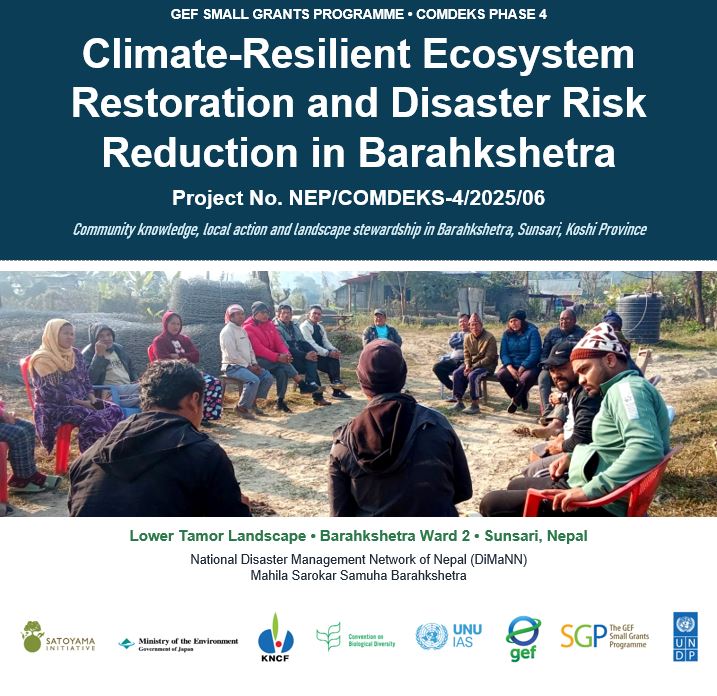
The project Climate-Resilient Ecosystem Restoration and Disaster Risk Reduction in Barahkshetra was implemented by the National Disaster Management Network of Nepal (DiMaNN) under the GEF Small Grants Programme’s COMDEKS Phase 4. Running from November 2025 to September 2026, the project focused on Barahkshetra Ward No. 2, Sunsari District, Koshi Province, Nepal. It aimed to strengthen ecosystem restoration, reduce disaster risks, mitigate human–wildlife conflict, and promote climate-resilient livelihoods through community participation, nature-based solutions, and collaboration with local institutions.
The project mobilized six community groups comprising 123 members, including 87 women and 36 men, and strengthened their capacities in community-based planning, disaster risk reduction, environmental restoration, and sustainable livelihood practices. Activities included participatory vulnerability and capacity assessments, community planning, training on organic fertilizers and pesticides, vegetable seed distribution, tunnel farming, and the promotion of climate-smart agriculture. Five vegetable-farming tunnels were established, and 117 people—84 women and 33 men—participated in vegetable production activities. The project also supported livelihood opportunities for two households with persons with disabilities and promoted locally suitable, climate-resilient enterprises, including lemon cultivation, beekeeping, and chilli and turmeric production.
To address river erosion, flooding, and environmental degradation, the project implemented riverbank bioengineering using bamboo and other locally available materials, alongside plantation and land-stabilization activities. Approximately 2,000 metres of riverbank protection were documented, and 10,061 saplings were planted, exceeding the planned plantation target of 3,000. The project also established approximately 1.6 kilometres of solar fencing, surpassing the planned one-kilometre target, and planted 1,858 lemon plants as part of buffer planting and human–wildlife conflict mitigation efforts. An elephant-monitoring tower and early-warning measures were introduced to improve community preparedness and response to wildlife-related risks.
Implementation was supported by collaboration among the municipality, Division Forest Office, Ward Committee, Community Forest User Groups (CFUGs), community groups, and local beneficiaries. Community members contributed labour, local knowledge, and other resources, helping strengthen ownership of the interventions and supporting their maintenance beyond the project period. The project also documented indigenous and local practices, promoted coordination for disaster risk reduction, and conducted monitoring and final assessment activities. Its approach demonstrated how ecosystem restoration, disaster risk reduction, human–wildlife conflict mitigation, and livelihood improvement can be integrated through locally appropriate solutions.
The project contributed to improved livelihood opportunities and well-being for 117 beneficiaries and strengthened the capacities of six community groups. Women played a significant role in implementation and decision-making, with three of the six groups led by women, including one led by a Dalit woman. Women’s participation in community organizations and natural-resource governance was also documented. The project’s combination of organic farming, tunnel cultivation, plantation, riverbank bioengineering, and solar fencing established a foundation for continued environmental management and climate resilience at the community level.
Key lessons from the project highlighted the importance of combining local knowledge and community labour with technical support and coordination among stakeholders. Community ownership and institutional collaboration helped the project exceed several physical output targets while developing practical skills and encouraging sustainable livelihood practices. Challenges included recurrent river erosion and flooding, pressure from elephants, and the need for stronger documentary evidence and technical measurements for some outcome indicators. Future initiatives could build on these achievements by strengthening monitoring and documentation, supporting women and youth leadership, consolidating emerging livelihood activities, and integrating successful practices into local and provincial planning to facilitate their wider replication.
Full Document is Available in : https://drive.google.com/file/d/10mvn8PW4n_8ZrPC32vcuvtHVxWeqzrOe/view?usp=sharing
Notice: Test mode is enabled. While in test mode no live donations are processed.
Leave A Comment